
A helium turboexpander and a heat exchanger perform different jobs within one thermal system. Their value depends on how they interact with compression, purification, return flows and the required cold duty. For a buyer, the useful starting point is the process and its boundaries: what enters, what leaves, which utilities are consumed, and where performance is measured.
Where the heat goes
The compressor supplies work to raise gas pressure. Compression also heats the gas; intercooling and aftercooling reject heat to an external cooling medium. A cold-box recuperator has a different role. It transfers heat from incoming warmer helium to colder returning helium through a separating wall, recovering the return stream's cooling potential without mixing the streams.
Recuperation alone does not supply all the refrigeration. The full balance includes compressor input, expansion work, useful cooling or liquid production, incoming and outgoing fluid energy, and heat entering through insulation and connections. A good component can underperform in a mismatched cycle. See also vacuum insulation, MLI and thermal shields.
Two expansion processes, different effects
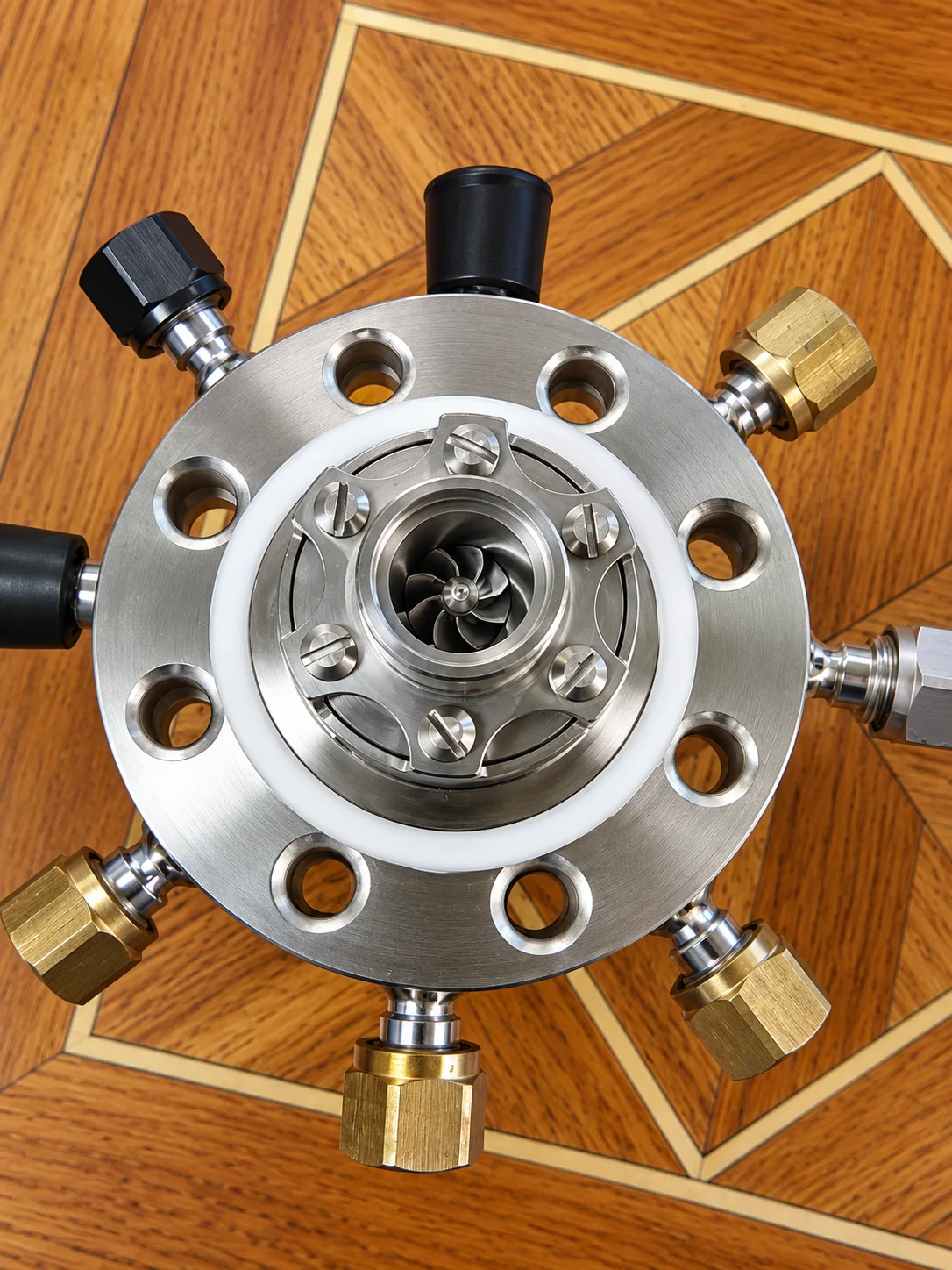
In a turboexpander, helium expands while producing mechanical work. Energy leaves the gas through the rotating machine, lowering its enthalpy, the energy carried per unit mass in a flowing stream. The colder outlet gas can then absorb heat from other streams. The useful result depends on inlet conditions, outlet pressure, flow and machine efficiency.
A Joule-Thomson, or JT, valve reduces pressure without producing shaft work. In the usual idealized throttling model, enthalpy remains constant. A pressure decrease does not guarantee a temperature decrease: the effect depends on the gas and its starting state. Helium requires suitable precooling and pressure conditions for useful JT cooling and partial liquefaction.
In a Claude-type arrangement, expansion machines help cool a separate high-pressure stream before its JT stage. The detailed flow split and number of stages vary; a helium cycle is not simply a line of interchangeable cold components.
- Compression and heat rejection
Compressor work raises pressure; cooling removes compression heat. Gas treatment supports the required purity.
- Recuperative cooling
Returning cold helium absorbs heat from the incoming high-pressure flow across exchanger walls.
- Separate cold branches
One fraction expands through turbine machinery and joins the return side. Another fraction continues through further heat exchange toward a JT stage and liquid separation.
- Return and useful output
Vapour and expanded gas recover cooling through the exchangers before returning to compression. Liquid withdrawal or a refrigeration load defines the output.
Why exchanger effectiveness is not enough
Effectiveness compares actual heat transfer with the theoretical maximum for defined inlet conditions and flows. It is useful, but does not establish the outlet state or the overall plant performance by itself. A technical review should connect it to four questions:
- Pressure drop: what losses occur on each side? Improving heat transfer by increasing flow resistance can consume pressure available elsewhere and increase compression demand.
- Cold-end approach: how close do the stream temperatures become at the cold end, and where is their minimum separation along the exchanger? Unequal flows and changing helium properties affect this profile.
- Flow distribution: do parallel channels receive the intended shares? Uneven distribution can leave surface poorly used even when the total flow appears correct.
- Construction: are materials, joints, cleanliness and thermal contraction compatible with the specified duty? These require design and fabrication records, not a photograph-based assessment.
Contamination is another system concern. Moisture, air constituents or oil carryover can deposit or freeze in cold passages, restrict flow and change performance. Purification, oil removal where applicable, and verified cleanliness belong in the review. A modern equipment example is described in A. Alekseev's CERN school chapter on low-temperature refrigeration (PDF), especially sections 3.3 and 4.1.
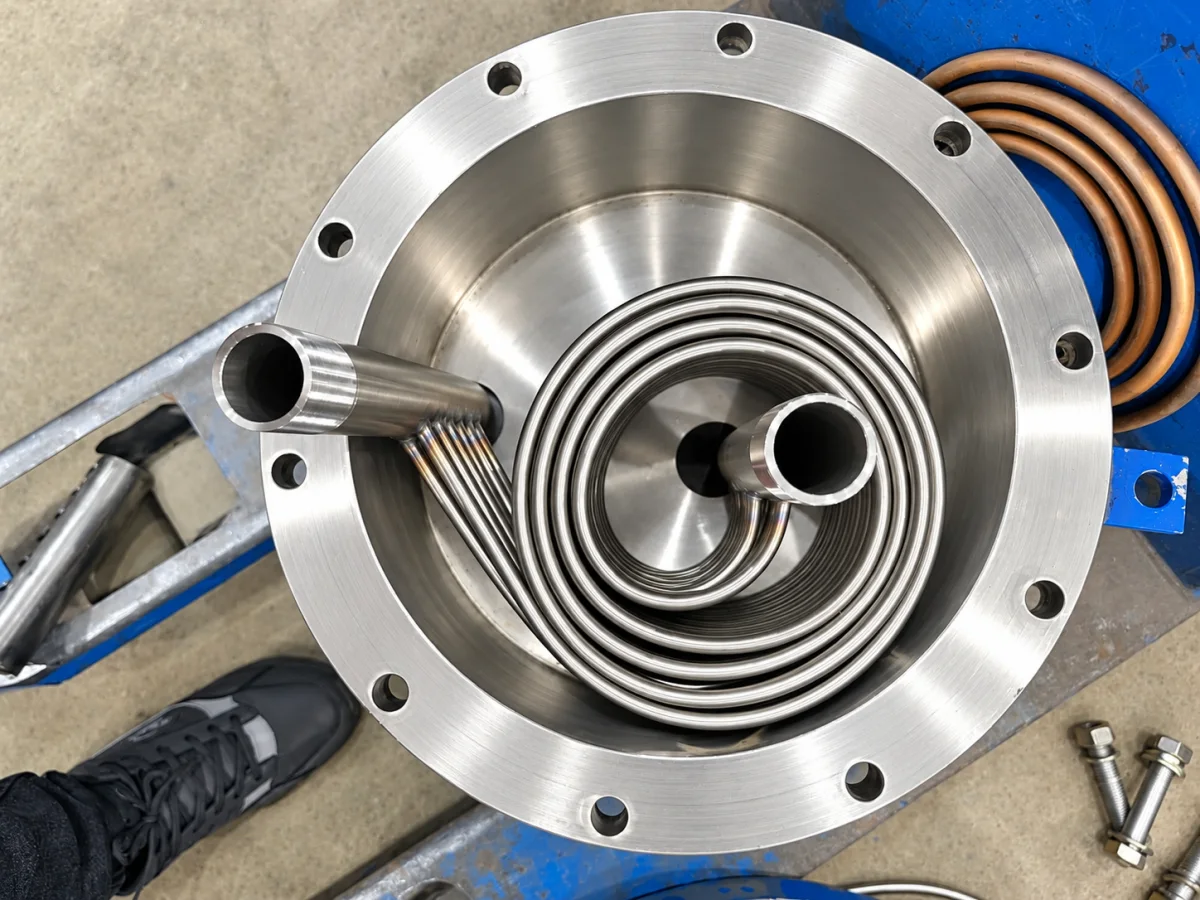
These existing engineering photographs illustrate separate components. They do not identify a matched cycle or demonstrate measured capacity, efficiency or acceptance-test results.
Litres per hour and watts describe different duties
Liquefaction capacity in L/h describes liquid production under stated feed, product and utility conditions. Refrigeration capacity in W describes heat removal at a stated temperature and under stated return conditions. Cooling incoming warm gas and producing liquid is a different duty from absorbing heat while receiving a cold return stream. There is no universal conversion between the two ratings. A latent-heat calculation alone does not compare complete plants.
What makes an offer comparable?
Ask for a common process basis, heat and mass balance, component duties, utility requirements and an agreed acceptance test. Identify measurement boundaries, instrument uncertainty, operating mode and whether output is measured at the cold box or after transfer to storage. The supplier should distinguish calculated performance from measured results.
Begin with the required helium supply form and application, then connect the equipment discussion to the project context. For delivered liquid, also account for storage and transfer losses.
Source and scope notes
Prepared by SG TRADING L.L.C-FZ, 21 October 2026. Historical foundation: Technology of Liquid Helium, NBS Monograph 111 (1968, original PDF), sections 3.1.1 and 3.1.3 (JT and work-producing expansion), 3.2.1-3.2.3 (liquefaction cycles and heat exchange), 4.3.1 (refrigeration versus liquefaction) and 4.4.2 (heat-exchanger performance). Publication details: NIST record. Modern cross-check: Alekseev, Basics of Low-temperature Refrigeration, CERN Yellow Report CERN-2014-005, pages 111-139; arXiv posting 29 January 2015.
Historical equipment values are not specifications for modern equipment. This guide explains principles and procurement questions; it is not a design, commissioning or operating procedure.