
A high-purity gas specification is a set of questions about individual contaminants. Which impurities matter to the process? How low must each be? Can the analytical method support that decision in the gas being supplied?
For buyers, the useful starting point is an impurity schedule with agreed limits and reporting requirements. A purity grade alone gives less information about how a particular gas will be assessed. Our semiconductor process gas specification guide explores how to turn those requirements into a purchasing specification.
Gas chromatography, laser spectroscopy and coulometric analysis can contribute different evidence. Their value comes from a suitable combination of methods, a representative sample and a clear interpretation of the result. Adding another instrument is useful when it answers a defined analytical question.
What chromatography does, and what the detector does
Gas chromatography separates components as they move through a column. Differences in their interaction with the stationary phase cause them to reach the detector at different times. The detector produces a response, recorded as a chromatogram. Reference measurements help identify peaks and relate their size to the amount of a component. NIST's explanation of gas chromatography describes these distinct functions.
A sensitive detector therefore remains dependent on a suitable separation. If two substances arrive together, interpreting their combined response can be difficult. The analytical method must demonstrate that the target impurity can be distinguished in the presence of the main gas and other expected components. For a purchaser, the relevant question is whether the complete method covers the specified impurities in the intended matrix.
Where VICI PDD fits
VICI, a name derived from Valco Instruments Company Inc., encompasses companies making analytical components including valves, injectors, fittings and detectors. These components have roles within analytical systems; the manufacturer's name does not by itself define a laboratory's complete method.
A Pulsed Discharge Detector (PDD) uses a pulsed electrical discharge. In VICI's documented helium ionisation mode, radiation from helium ionises column effluent and generates a measurable response.
In VICI's D-2/D-2-I manual, revision 2/14, PDHID denotes helium ionisation; other described modes are selective photoionisation (PDPID) and electron capture (PDECD), depending on configuration. PDD does not mean one identical mode in every instrument.
A detector's published sensitivity cannot establish the detection capability of a complete laboratory method in every gas.
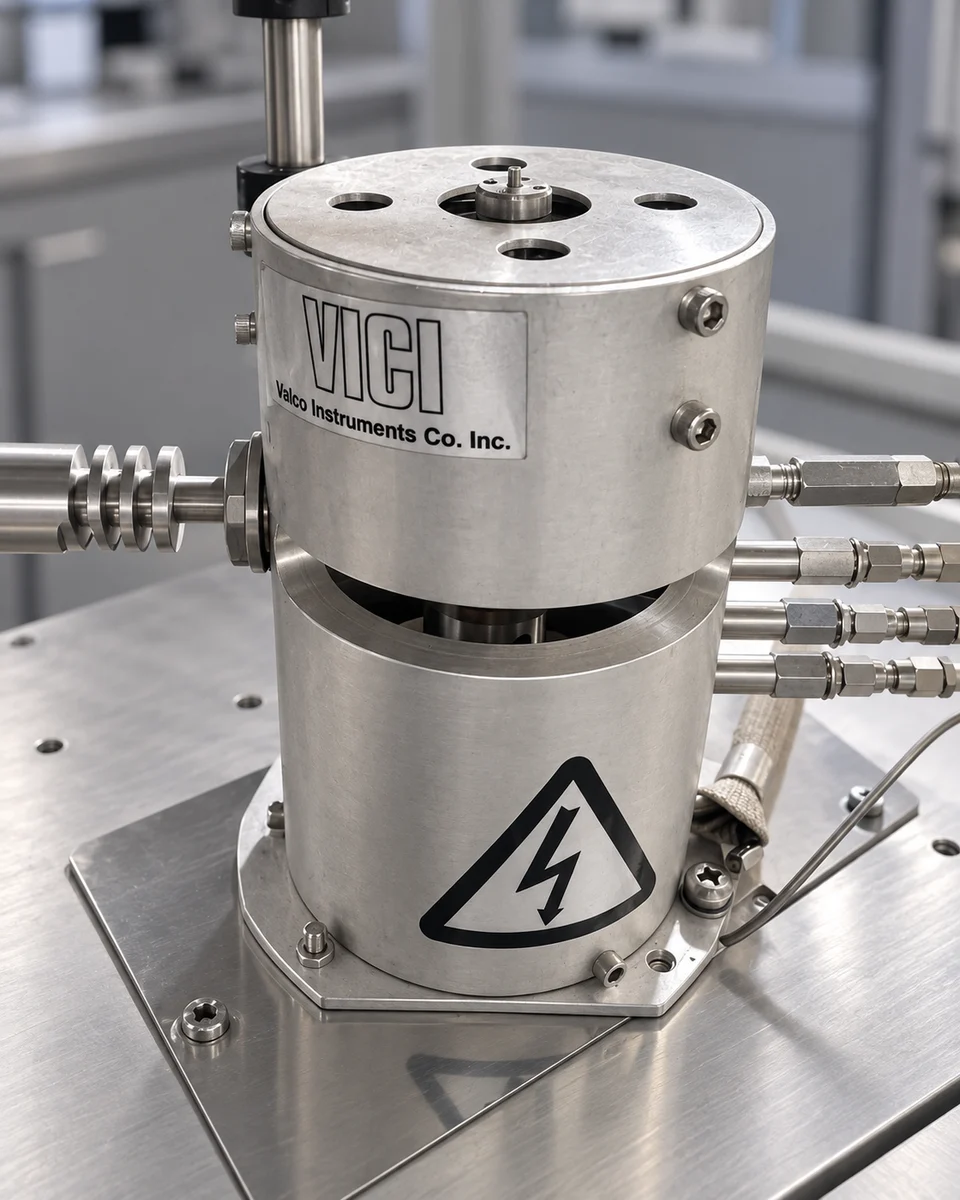
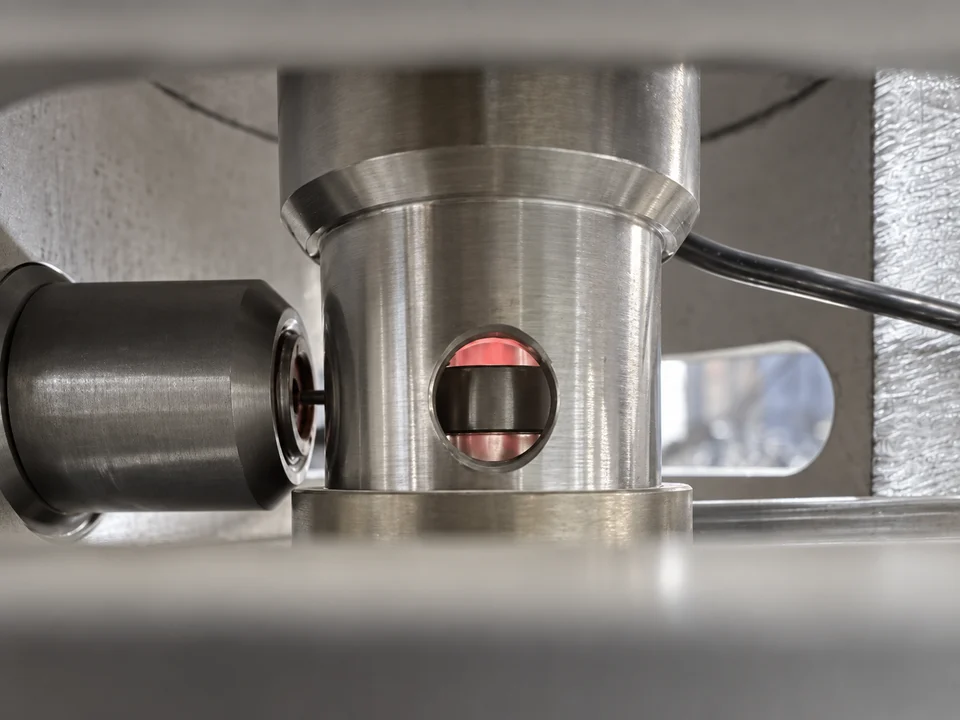
These images are illustrative, not verification of a model, operating condition or analytical performance. Follow the manufacturer's safety instructions; do not access the internal parts of an operating detector.
Why trace neon in helium needs particular care
Neon is a demanding case. VICI's manual, pages 1–2, describes a weak neon response: its 21.56 eV ionisation energy exceeds the 13.5–17.7 eV helium emission continuum involved in the principal photoionisation mechanism. The manual mentions an enhanced detector for neon, so it would be wrong to say that all PDD configurations cannot measure it.
Helium can also be the carrier and discharge gas. Those roles differ from helium as the sample. Instrument-gas purity and background response need review; the manual's gas-supply requirements are not sample detection limits.
Published research using a helium PDD demonstrates neon measurement, but reports a weaker, nonlinear response. Its application was air extracted from polar ice, not commercial helium. Those results cannot validate a supplier's Ne-in-He method.
For a helium supply, ask for demonstrated neon performance in the relevant matrix: suitable calibration, separation from interfering components, blank control, repeatability, uncertainty, and method-specific detection and quantification limits. Sensitivity to another impurity is not a substitute. Dedicated moisture or oxygen measurements provide information about those impurities, not the neon content.
Laser analysis for selected impurities
An optical analyser can target a characteristic absorption feature of a particular substance. With tunable diode laser absorption spectroscopy, commonly called TDLAS or TDL, the laser scans an absorption line and the measured change in light intensity is used to determine concentration. Servomex's TDL explanation also identifies temperature, pressure and optical effects that require consideration.
This makes laser analysis useful for a defined measurement task, such as moisture in a supported background gas. A dedicated moisture measurement can complement the impurity coverage provided by chromatography, while a suitable second method can help investigate a disputed result.
Selection must remain specific to the analyte, gas matrix and concentration range. “Laser analyser” is a technology description, not a guarantee that one instrument measures every impurity or works with every rare gas.
Coulometric oxygen measurement has a specific role
In Servomex's coulometric oxygen technology, oxygen from the sample is reduced at a cathode and the resulting current is related to oxygen content. This is an oxygen measurement. The description and performance of that sensor must not be transferred to a coulometric moisture analyser, which requires its own documented measurement principle and application limits.
A practical manufacturer example is the SERVOPRO DF-760E: its moisture measurement uses TDL technology and its oxygen measurement uses a coulometric sensor. Servomex names supported background gases including nitrogen, hydrogen, helium and argon; for an oxygen background, the stated application is moisture measurement only.
The example illustrates how different channels can address different contaminants. It does not establish suitability for neon, krypton or xenon, or describe equipment operated by SG Special Gases.
The sample path is part of the measurement
The laboratory measures the gas that reaches its instrument. The connection between the cylinder and that instrument must preserve the information the test is intended to obtain. Linde's specialty equipment guidance treats supply equipment as part of maintaining gas integrity between its source and the instrument or process.
Moisture is a useful example. Vaisala's sampling guidance explains the effects of ambient leaks, moisture movement through materials and moisture absorption by those materials. These influences can make a sampling system affect the reading. The same guidance notes that dew point changes with pressure, so dew-point values taken at different pressures need careful comparison.
For a technical review, ask where and when the sample was taken, how it was identified, which sampling arrangement was used and whether the recorded conditions match the method. Sampling and equipment preparation belong in controlled procedures carried out by qualified personnel.
Calibration gives the response meaning
An instrument response becomes useful through a defensible relationship to the quantity being measured. Linde's description of calibration mixtures discusses calibration across an intended range, together with mixture uncertainty, traceability and stability. Buyers can ask which reference materials support the reported results and whether the calibration covers their acceptance limits.
The low end of the measurement needs attention too. The NPL abstract on zero-gas reference standards identifies residual impurities in zero gas as a contributor to measurement uncertainty. A nominal zero reference should not simply be assumed to contain none of the target impurity.
Ask for evidence of continuing performance as well: relevant blank results, repeatability and appropriate quality-control checks. Agreement between repeated readings addresses consistency; the suitability of the calibration and reference materials still requires its own assessment.
Detection, quantification and the meaning of “less than”
The limit of detection concerns the level detectable with a stated confidence. The limit of quantification concerns the lowest level measurable with acceptable performance for the intended use. Eurachem's 2025 method-validation guide distinguishes both from an instrument-only detection limit: method performance needs to reflect the complete measurement procedure and relevant matrix.
On a Certificate of Analysis, preserve the symbol < whenever it forms part of the reported result. A value reported below a stated threshold is not a measured zero. Ask whether that threshold represents a detection limit, quantification limit or another reporting convention. Also distinguish the measured result from the specification limit against which it is judged.
Measurement uncertainty provides further context. The international metrology vocabulary describes a measurement result as generally including a measured value and its uncertainty. Where a result approaches an acceptance limit, the parties should agree how that uncertainty enters the acceptance decision.
When methods disagree
A disagreement is a reason to investigate. First compare the sample identity, sampling time, units, reporting basis and applicable limits. Then review calibration, blank readings, sampling conditions, possible contamination and the suitability of each method for that matrix.
Do not average conflicting values merely to produce a single convenient answer. The technical review should establish whether the methods measured comparable samples under comparable conditions and whether the difference is meaningful given their uncertainties. Further testing should address the suspected cause and document the resolution.
For purchases of neon, xenon or krypton, request a certificate linked to the relevant cylinder or batch, with named impurities, specification limits, results, units and sufficient method information. Use the quality documentation overview to frame that discussion. The evidence should allow both buyer and supplier to understand the same acceptance decision.
For each critical impurity, agree the limit, suitable method, sample conditions and reporting basis. A complementary method is useful when it addresses a specific gap or independently checks the same analyte. Two instruments sharing an unsuitable sample path can still share the same error.
See also gas-cylinder service changes and neon supply and packaging. For a supply enquiry, include the required impurity limits and analytical evidence in your RFQ.
Sources and scope
Sources reviewed on 22 September 2026 and linked beside the relevant statements. This is an educational procurement guide, not an operating procedure or an offer of laboratory testing. Named manufacturer examples do not imply an SG Trading-owned laboratory, accreditation, equipment ownership or commercial affiliation.
The VICI discussion is limited to the cited D-2/D-2-I manual, Rev. 2/14, pages 1–2 and 10–12. The neon research concerns polar-ice air samples. NPL's zero-gas source is an abstract; Eurachem's cited guide is the 2025 third edition. Performance must be established for the actual analyte, matrix and complete method.