
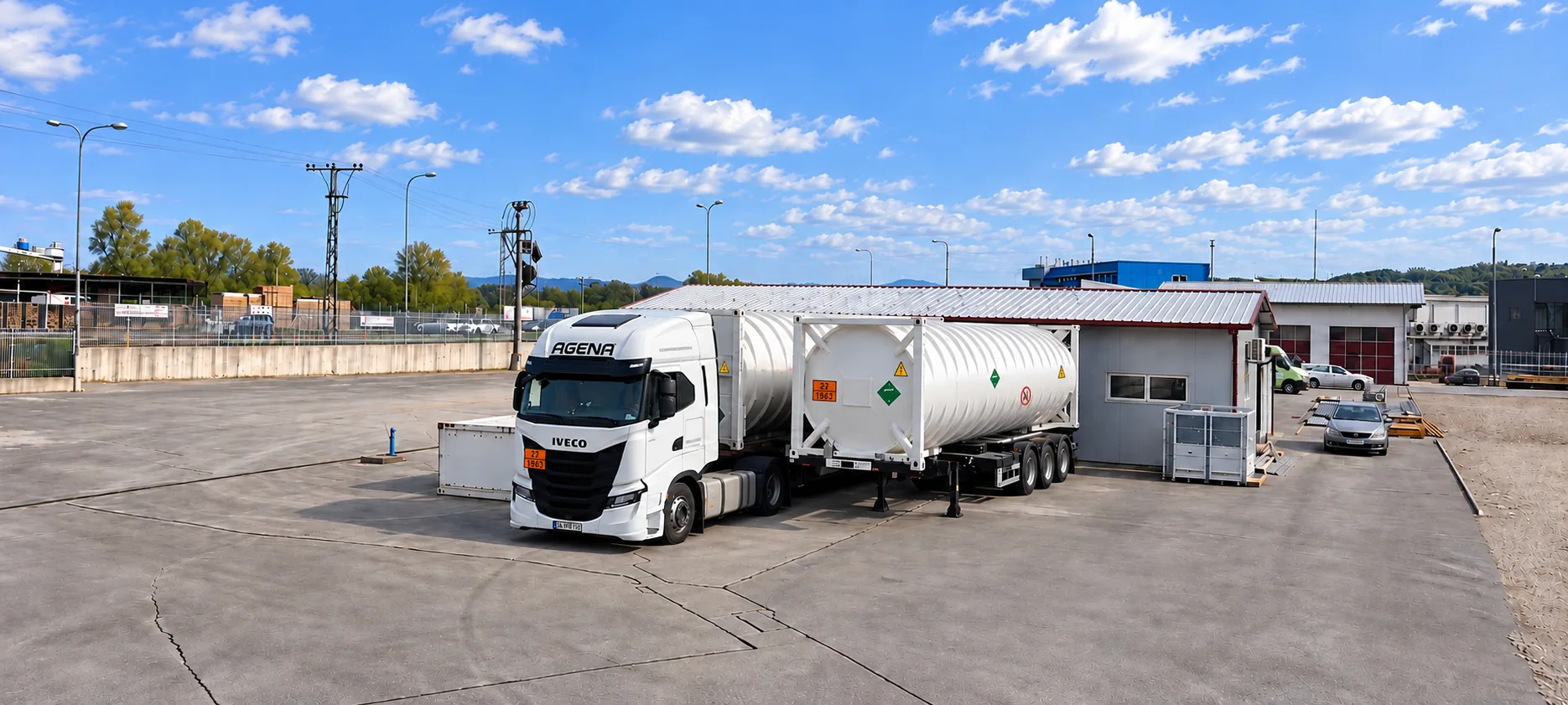
A helium purchase depends on two kinds of availability: the product and the equipment needed to deliver it. When a liquid-helium container is delayed on its outward journey, at the receiving site or on its return, it is unavailable for the next loading. That makes container circulation part of the supply picture.
A documented response to disruption
In its 30 April 2026 results announcement, Air Products reported repositioning part of its ISO-container fleet to manage helium supply flows. Its other measures included increasing US production and liquefaction and drawing on cavern storage. The announcement shows that equipment positioning matters alongside gas production. It does not establish a current count of stranded containers.
The container is specialist equipment
A liquid-helium tank is not interchangeable with a general-purpose freight container. Gardner Cryogenics, for example, describes a 41,640-litre UN portable tank in a 40-foot ISO frame for road and ocean transport. Linde’s HELICS offering includes cool-down, maintenance and inspection support as well as the vessel itself. Equipment readiness therefore belongs in the shipment plan.
Longer circulation means fewer deliveries
For planning, count the whole cycle: preparation and filling, outbound transport, receiving and unloading, return transport, and readiness for the next fill. A delay anywhere in that cycle ties up equipment.
Assume the same number of serviceable containers, the same usable payload per trip and continuous demand. If the complete round trip increases from 60 to 90 days, theoretical delivery capacity becomes 60 ÷ 90 = 67% of its previous level, a reduction of about one third.
This is an illustrative steady-state calculation, not measured fleet data. The round trip includes the return leg; these figures are not permissible loaded-storage periods or holding-time specifications.
The calculation explains why extra production capacity and extra deliverable supply are different things. Recovering the transport cycle can improve availability without changing the number of containers.
Six points to settle before dispatch
- Equipment allocation: which suitable vessel is reserved, and when will it be ready at the loading point?
- The complete route: who confirms carrier acceptance, transfers, customs arrangements and likely waiting periods?
- Thermal planning: what do the specific vessel’s documents and operating condition allow, and how will delays be managed? Use its approved procedures and qualified operator’s assessment.
- Receiving readiness: are the unloading slot, trained team, connections and receiving vessel available?
- The return: where must the container go, by when, who books and pays for it, and what happens if the return is delayed?
- Delivery evidence: what quantity and quality records define acceptance, and who coordinates a changed schedule?
Keep price claims tied to their basis
Price changes are specific to a supplier, market, product and date. Nippon Sanso’s 19 June 2026 notice, for example, announced an average increase of 30% or more for helium-related shipments from July. That is a supplier announcement, not a universal market index.
For a usable comparison, request the product state, quantity basis, packaging, named delivery point, quote validity, freight scope and return obligations. A gas-only price and a delivered price with a vessel included answer different purchasing questions.
Build the transport cycle into the RFQ
Use our liquid-helium RFQ checklist to specify the delivery and return together. The storage and transfer losses guide explains why delivered liquid quantity needs its own definition. For the broader market context, read Helium Supply Risks: What Buyers Should Review Now.
Source context: the company announcements above were published in April and June 2026. This briefing was prepared on 29 October 2026 and does not report a new October disruption. The circulation example and purchasing checklist are SG Trading’s explanatory analysis.