
A cryogenic tank container may look like a single large cylinder in a frame. Its suitability for a particular gas, however, depends on much more than its appearance. Understanding the T75 designation starts with separating three questions: which instruction applies, how the equipment is built, and what the identified tank is approved to carry.
What does T75 mean?
T75 is a portable-tank instruction for refrigerated liquefied gases. In ADR, it points to construction and use requirements; it is not a manufacturer’s model number. The designation alone does not prescribe one capacity, steel grade, pressure rating or list of permitted cargoes. Applicable transport rules and the individual design approval must be read together. See ADR 2025, Volume II, sections 4.2.3, 4.2.5.2.6 and 6.7.4 (PDF).
T75 identifies the instruction. The tank’s plate, approval and inspection records identify the equipment and its permitted service.
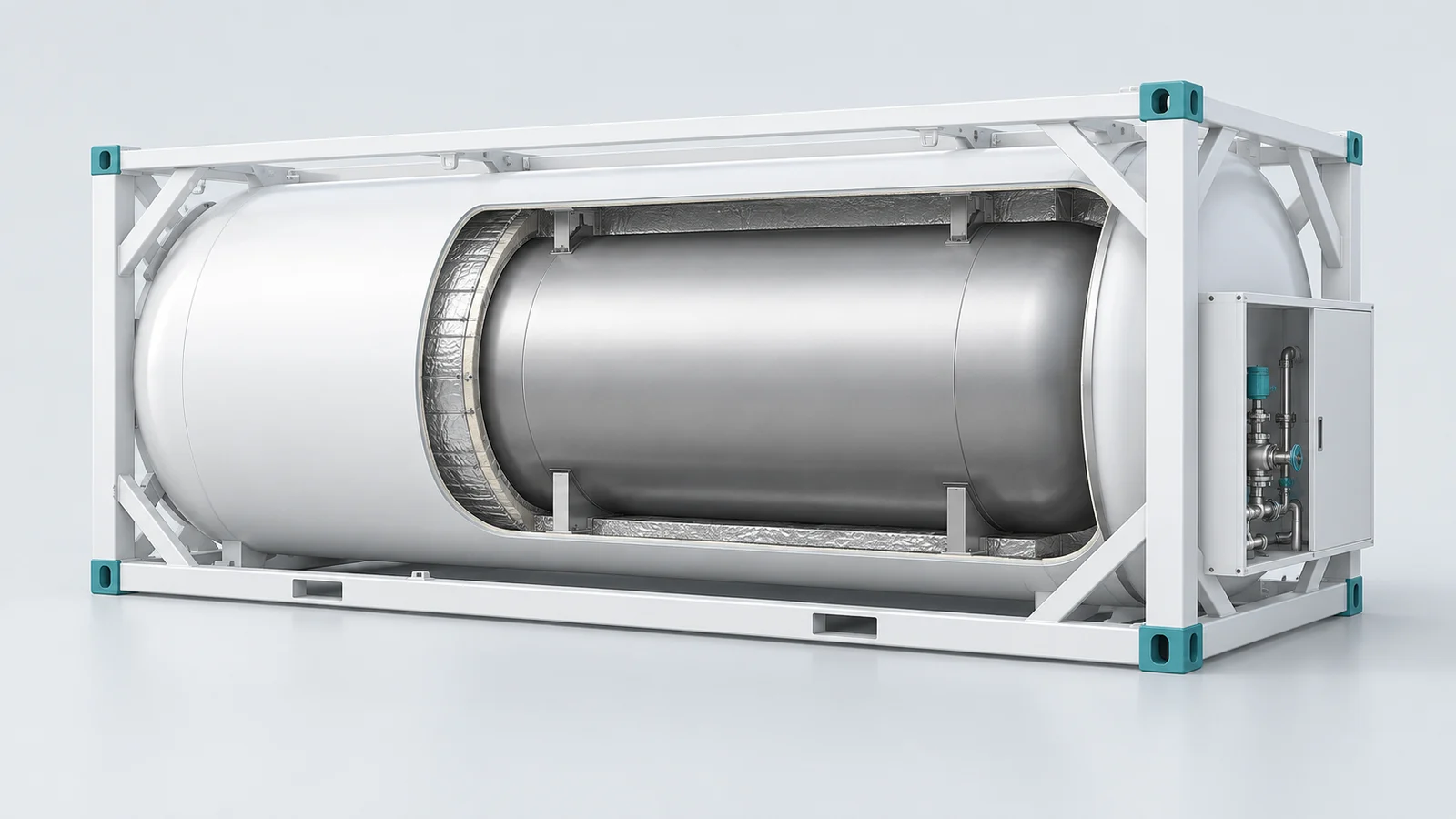
Inside a vacuum-insulated design
The illustration separates four elements that perform different jobs:
- Inner vessel: the shell that contains the refrigerated liquid.
- Insulation space: in a vacuum-insulated design, the evacuated gap and any additional insulation reduce heat entering the inner vessel.
- Outer jacket: the enclosure around the insulation system.
- Supporting frame: the external structure for supporting and handling the assembly.
This is one design principle, not a universal construction drawing. Portable-tank rules also recognize solid-insulation arrangements. Specific materials, supports and insulation layers must come from the approved design. The definitions in US 49 CFR §178.277 distinguish the shell, jacket and insulation system.
Which characteristics belong to the individual tank?
A useful technical comparison begins with the records for the same identified unit, not numbers collected from unrelated brochures. Keep these fields separate:
- Capacity and allowable load
- Internal volume is not the same as the permitted mass of a particular cargo. Check both the vessel data and the applicable loading limits.
- Pressure and temperature
- Do not interchange design pressure, maximum allowable working pressure, normal operating pressure and test pressure. Check the documented temperature range as well as pressure.
- Materials and construction code
- Identify the materials for the shell and jacket separately. Confirm the documented code and approvals; “T75” alone does not establish an ASME certification.
- Approved cargo and equipment
- Confirm the intended gas against the approval and operating documentation, including the suitability of the fittings and interfaces.
For example, a published initial inspection certificate for one CIMC container (PDF) records capacity, shell and jacket materials, working and test pressures, temperature range and cargo references separately. Those values describe that identified unit, not every T75 container. This third-party example does not represent SG Trading inventory.
For US transport, 49 CFR §173.32 addresses selection of an authorized tank, appropriate pressure ratings and loading requirements. Other routes require assessment under their applicable framework.
Holding time is conditional
Holding time relates to how long it takes for the contents to reach the relevant pressure-limiting threshold under defined conditions. Insulation performance, the gas, initial filling conditions, ambient assumptions and pressure settings all affect the result. A duration quoted without its conditions is not a journey guarantee. The factors are set out in 49 CFR §178.277(b)(10).
For planning, ask which documented conditions the figure assumes and whether the proposed journey, including delays, matches them. Apply the holding-time requirements relevant to the transport mode and route. This article does not provide a calculation or an operating procedure.
Why liquid helium needs a separate assessment
Approval for liquid nitrogen, oxygen or argon does not establish suitability for liquid helium. Helium’s normal boiling temperature is approximately −269°C, and helium transport requires equipment specifically designed and approved for that service.
The Linde HELICS brochure (2019, PDF) illustrates a dedicated helium-container design with a liquid-nitrogen shield and stated holding-time conditions. It is a useful design example, not a specification for every helium tank or a statement of current availability.
Why identification and inspection records matter
Inspection status and service history are part of the assessment, alongside design approval. Check that the plate, certificates and records refer to the same unit. Periodic inspections and tests have equipment-specific requirements and exceptions; a general interval quoted online is not enough to determine the next action for an individual tank. The US framework is described in 49 CFR §180.605.
For context on the existing service, see industrial asset inspection and the inspection-scope guide for tube trailers, T50 and T75. An educational explanation or a visual condition review does not replace an authorized inspection, approved operating instructions or a statutory certificate.
Three common questions
Does T75 mean any cryogenic gas can be carried?
No. Check the permitted cargo and the identified tank’s design and equipment. Similar-looking containers may have different approvals and service limits.
Does a larger tank mean better thermal performance?
Capacity alone does not answer that question. Compare documented thermal performance and its conditions separately from the volume and payload.
Is this page a tank sales or rental offer?
No. This is an educational Insights article. It does not list containers for sale or hire, establish availability, or recommend a particular model.
Source and scope notes
Prepared by SG TRADING L.L.C-FZ. Sources reviewed on 20 September 2026. ADR 2025 and the cited US rules are separate frameworks, not interchangeable global requirements. Manufacturer and certificate examples apply only to the equipment they identify. Links appear beside the relevant explanation so readers can check the original context.
This overview is not a design, filling, maintenance or emergency-response procedure. Equipment-specific decisions require the approved records, current applicable rules and competent personnel.