
Follow a litre of liquid methane out of a rocket tank. It runs towards the engine, where a pump raises its pressure before it reaches the combustion chamber. Back in the tank, the gas above the liquid now has an extra litre of space to occupy. The same thing is happening in the oxygen tank. Keep draining either one and the gas expands. How does the rocket keep enough pressure at the pump inlet for the liquid to flow smoothly?
Engineers call the space above the liquid the ullage. They feed gas into it as the liquid level falls. The pressure helps keep the propellant from boiling as it enters the pump. If pressure drops too far, vapour bubbles can form and then collapse inside the pump, a process called cavitation. Tank pressure and pump discharge pressure thus tell an engineer about two different parts of the same journey. NASA on tank pressure and pump inlet conditions.
Terran 1 borrowed gas from its own tanks
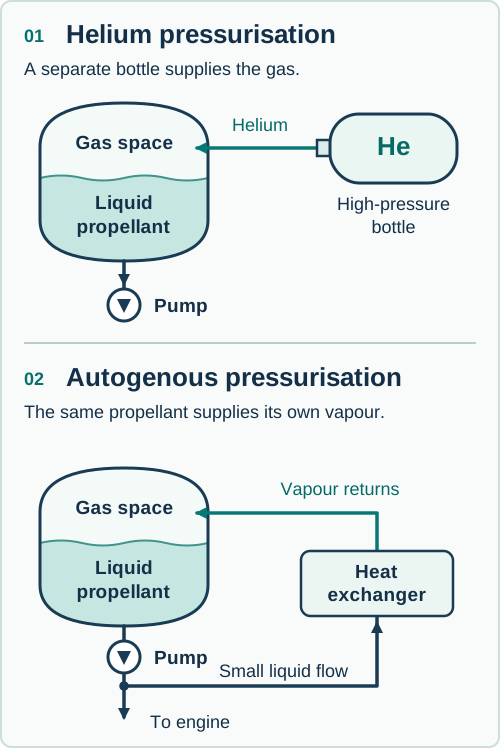
Terran 1 already carried two liquids that could do the job. A small flow of methane passed through a heat exchanger at the engine. Heat turned it into gas, and a line carried it back to the top of the methane tank. On the oxygen side, a separate heat exchanger returned gaseous oxygen to the oxygen tank. This arrangement, called autogenous pressurisation, kept the two streams separate and used some of the heat available while the engine was running. Tim Ellis describes the two circuits and their ground tests.
There is a catch on the return trip. Warm methane vapour enters a tank containing very cold liquid methane. Some of the vapour can turn straight back into liquid on contact with a cold surface. The methane is still on board, but those molecules have left the gas space and no longer sustain its pressure. A flow meter on the return line can tell you how much gas went in. It cannot tell you how much stayed there.
Why Terran R was designed to carry helium
Consider the interval between two engine burns. The tanks still need the right pressure for the next start, and hot gas from an engine heat exchanger is no longer available in the same way. When Relativity Space described the Terran R design in 2023, it identified pressure control with the engines off as a reason for choosing helium on both stages. In its 2025 design update, the company described storing helium in composite pressure vessels at both cryogenic and ambient temperatures. The system was designed to supply gas during a burn and between burns. Relativity’s explanation of the engineering choice · Terran R design update.
Helium has a useful property here. Its critical temperature is only about 5.2 kelvin. The liquid oxygen and methane in these tanks are much warmer than that, so neither can cool the helium enough to condense it. Cold tank walls can still draw heat out of helium and lower its pressure. The designer has to allow for that cooling, as well as for the mass and space taken up by the helium vessels. What the designer gains is a separate supply of gas that stays gaseous inside the propellant tank. NIST helium phase data.
A tank small enough to test on Earth
At NASA’s Lewis Research Center, engineers emptied liquid methane from a spherical tank just 1.52 metres across. They could change the gas entering the tank, the time allowed to drain it and even how much the liquid sloshed. Their 1974 report records what happened when they deliberately disturbed the surface. With methane vapour supplying the pressure, sloshing increased the amount of gas needed. Under similar test conditions, helium demand decreased slightly. The motion of the liquid mattered even though the tank and its outlet had stayed the same. DeWitt and McIntire’s original test report.
Two runs show what engineers could actually measure. In one, a drain lasting 389 seconds used 2.10 kg of helium. In another, with the incoming gas at almost the same temperature, a 405-second drain used 9.94 kg of methane gas. Of that methane, 3.29 kg condensed. Roughly one kilogram in every three admitted ended up back in the liquid. Methane molecules are also about four times heavier than helium atoms, so the two masses alone cannot tell us how much of the difference came from condensation. The separate measurement of condensed methane answers a question the inlet meter leaves open. NASA test tables, slides 8, 11 and 12.
The question to ask before quoting helium
“A methane rocket” tells a gas supplier what the vehicle burns. It still leaves open whether the customer needs helium on board, for a series of ground tests, or for both. A useful enquiry identifies which operation needs the gas, the quantity per test or fill, the delivery schedule, and the pressure and impurity limits at handover. If the order is expressed in cubic metres, it also gives the temperature and pressure to which that volume refers. Those details turn a description of a rocket into a requirement a supplier can quote. SG Trading helium supply · Gas quantities and reference conditions.