
Supplying high-purity helium also means understanding the traces of other substances travelling with it. Oxygen and water each deserve their own measurement. At SG Trading, we build a two-channel coulometric analyser to make those measurements part of our own work and our customers' quality control.
The instrument combines a heated solid-state electrolyte oxygen cell with a separate moisture cell operating at ambient temperature. It monitors the conditions around both measurements, rather than presenting concentration as an isolated number. We manufacture these analysers to order at our own facility for internal metrological support and for customers who need analytical control close to their process.
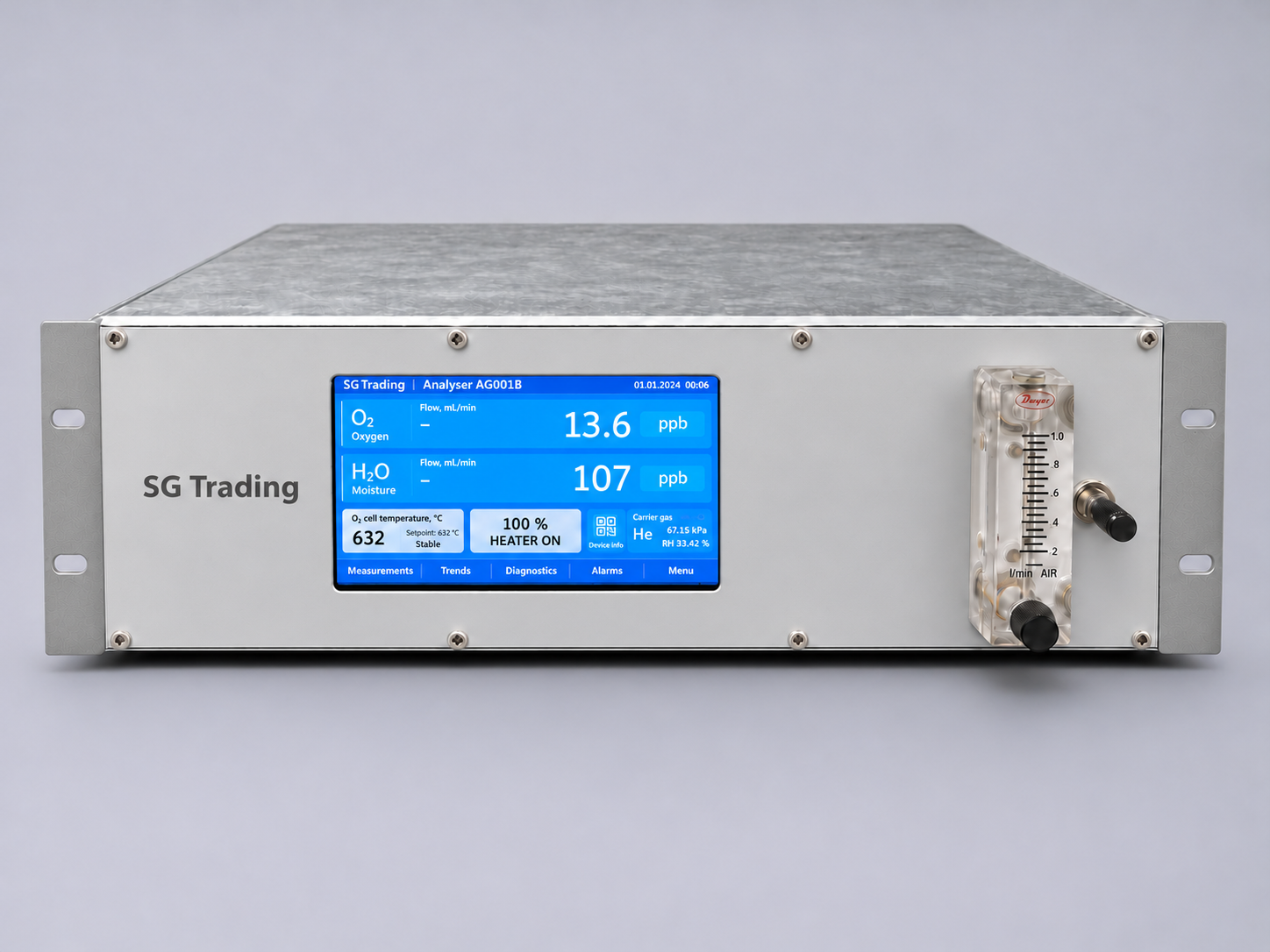
Our oxygen and moisture analyser. Photographs in this article are retouched; screen values and status are illustrative.
Coulometry: counting an electrochemical reaction
A coulometric detector connects a chemical quantity to electrical charge. When the target substance undergoes a defined electrochemical reaction, a corresponding number of electrons moves through the circuit. Measuring that charge gives a way to determine how much substance participated.
The relationship is described by Faraday's laws of electrolysis. In compact form, Q = zFn: charge Q equals the amount of substance n, multiplied by the number of electrons involved per molecule, z, and the Faraday constant, F. For a flowing sample, current describes the rate at which charge is transferred. Relating the net analytical current to the sample's molar flow gives the basis for a concentration measurement, provided the reaction is quantitative and background contributions are accounted for.
That last part matters. The detector must distinguish the signal associated with the impurity from its electrical and chemical background. A physically defined relationship is a strong starting point; the complete measurement still depends on the cell, electronics and gas reaching them.
Why our oxygen cell runs at 632 °C
Our oxygen channel uses a solid-state electrolyte cell operating at 632 ± 2 °C. Elevated temperature enables the required ion transport through the electrolyte. Holding that temperature within its operating band is therefore part of maintaining a consistent measurement environment.
In a general oxide-ion electrolysis example, an oxygen molecule accepts four electrons to form two oxide ions: O2 + 4e− → 2O2−. The associated current can be related to oxygen transfer. Research on solid-electrolyte oxygen coulometry shows why temperature stability, electronic background and current measurement all deserve attention.
The 632 °C reading is the temperature of the oxygen cell. It is not the temperature of the whole instrument, the incoming helium supply or the separate moisture cell. Keeping these meanings clear makes the display more useful to the person interpreting a result.
Water needs its own cell and its own conditions
Our moisture cell operates at ambient temperature, and the analyser measures its temperature separately. Sharing a chassis does not make oxygen and moisture the same analytical problem: they have different cell conditions and separate gas-flow measurements.
In electrolytic coulometric moisture analysis, the electrical response is related to water participating in an electrochemical reaction. A familiar implementation captures water and electrolyses it; two electron charges correspond to each water molecule decomposed. The NIST-hosted chapter on trace water-vapour analysis explains the relationship between electrolysis current, water content and sample flow. Cell construction and electrolyte chemistry determine how that principle is implemented.
Water also interacts with the sampling path. Moisture retained on a surface can continue entering a dry gas stream after a connection is changed. Watching the reading settle, alongside the flow and cell temperature, gives a more informative picture than relying on the first number after a new sample is connected.
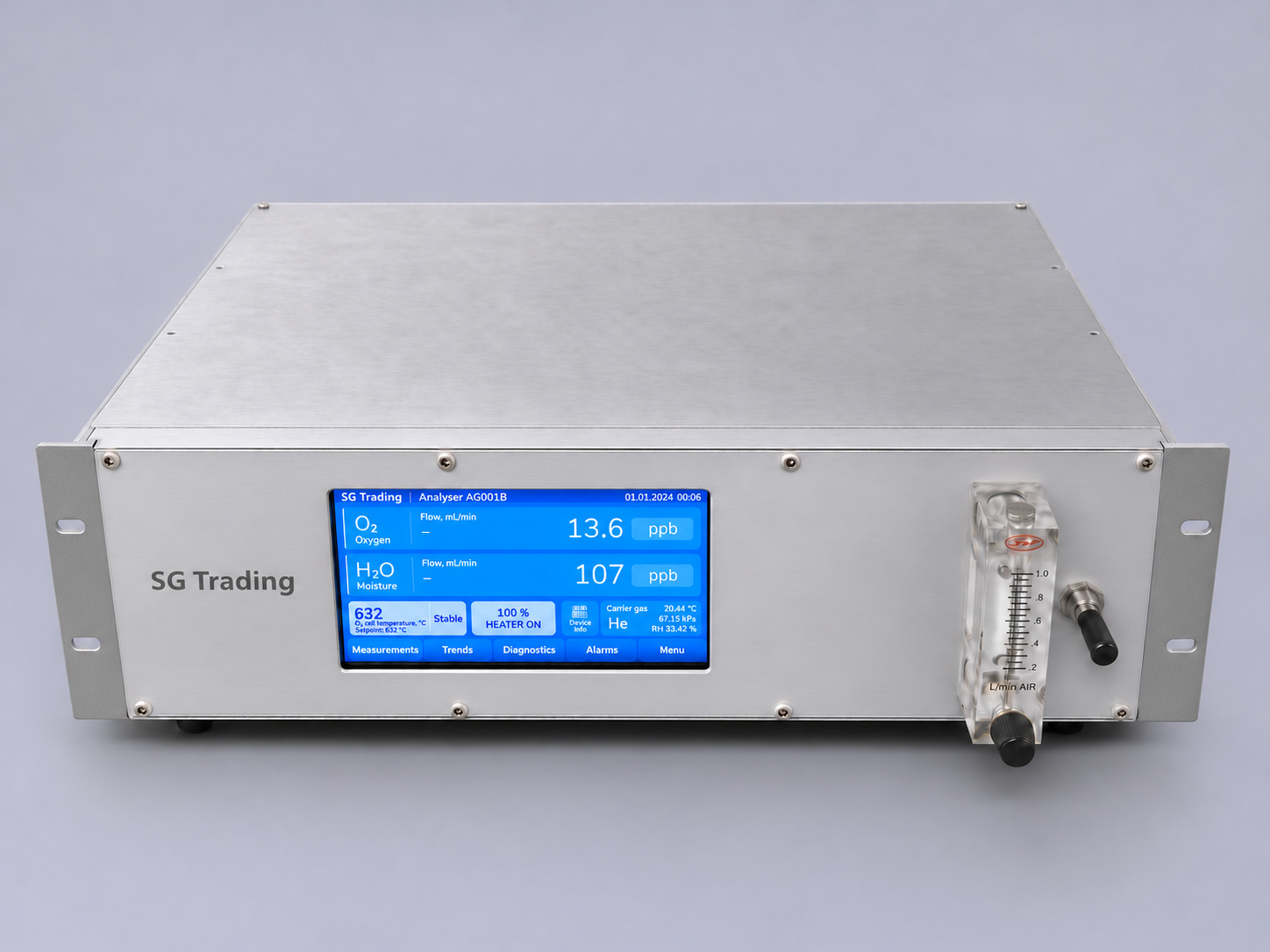
Enclosure, display and front-panel flowmeter.
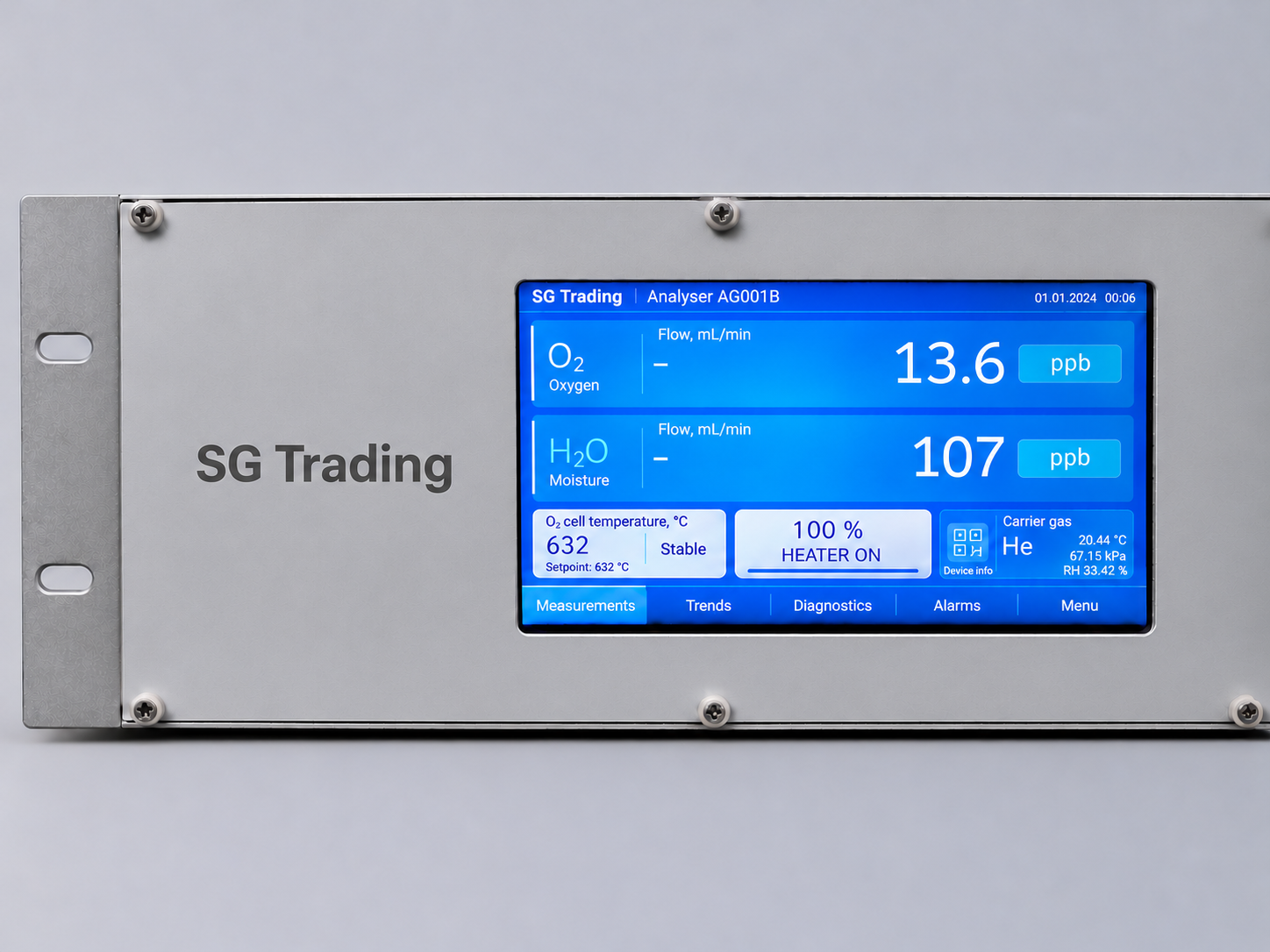
Two impurity channels and the oxygen-cell temperature.
Where the Nernst equation fits
Electrochemical gas analysis also draws on the Nernst equation, which relates an electrode's equilibrium potential to temperature and the chemical activities involved in its reaction. For an ideal oxygen concentration cell, the voltage depends on the logarithm of the ratio between reference-side and sample-side oxygen partial pressures.
Faraday relates transferred charge to an amount of substance. Nernst relates equilibrium voltage to chemical composition. A voltage measurement and a charge measurement are different ways of obtaining information from an electrochemical cell.
Some solid-electrolyte instruments combine these roles: one function transports oxygen electrochemically while another monitors oxygen potential. ZIROX's electrolysis application description provides an example. These relationships describe different parts of electrochemical measurement: voltage provides information about oxygen potential, while transferred charge accounts for oxygen moved through the cell.
The five conditions behind the two readings
Our analyser monitors oxygen-cell temperature, moisture-cell temperature, atmospheric pressure, oxygen-channel gas flow and moisture-channel gas flow. These values help establish the conditions under which the two concentrations are obtained.
Flow is especially important in a continuous coulometric measurement. If more sample passes through a cell each second, the same impurity fraction brings more impurity molecules to that cell. Current must therefore be interpreted together with the flow through the relevant channel. Each channel’s current must be interpreted with its own measured flow.
Temperature and pressure also matter when a volumetric flow is converted to the amount of gas passing per unit time. The relevant conditions are those at the flow measurement point. The hot oxygen-cell temperature is not a substitute for the temperature at a room-temperature flowmeter, and atmospheric pressure is not automatically the pressure inside a pressurised sample line.
This is why we view the analyser as a measurement system. The concentration, cell conditions and gas handling belong together. They also help an operator investigate a changing reading: has the sample changed, or have the conditions around the measurement changed?
What a ppb reading tells you
For amount fraction, 1 ppb means 1 nmol/mol, and 1 ppb equals 1,000 ppt. The WMO World Data Centre for Greenhouse Gases lists these unit relationships. An example reading of 13.6 ppb oxygen describes a different impurity from 107 ppb moisture; neither number should disappear inside an overall purity label.
A display unit is also distinct from a validated detection limit. The useful specification states the gas matrix, measurement range, response and uncertainty for each channel. Reference checks and a suitable sampling arrangement support that specification. Our guide to chromatography, laser analysis and coulometry explains how complementary methods build a fuller picture of gas quality.
Built for our gas work, and for yours
We are proud to build an instrument that connects our experience with helium supply to the practical work of measuring its impurities. Our aim is straightforward: give the user two meaningful results, together with the operating information needed to understand them.
For a made-to-order analyser, the starting point is the measurement task: which inert gas, which oxygen and moisture ranges, which sample pressure and connection, and how the results will be used. We can then discuss the instrument configuration and the evidence required for the customer's quality-control workflow.
Contact SG Trading about an analyser with your gas matrix, required concentration ranges and sampling conditions.
Technical references
References linked above explain the general electrochemical principles. Instrument configuration, operating temperatures and made-to-order manufacture are described by SG Trading. Published 23 November 2026.