
Beneath Italy’s Gran Sasso mountain, physicists use 988 crystals to look for an exceptionally rare nuclear decay. Each crystal has a thermometer. The sign of a particle depositing energy is a tiny rise in temperature, and the experiment needs a refrigerator cold enough for that change to stand out. At a neutron-scattering instrument in Maryland, physicists also look for particles. Their detectors report electrical pulses. Both experiments use helium-3. Follow a single atom in each and its job turns out to be quite different. Inside the CUORE detector · Inside the NIST spectrometer.
Ordinary helium is almost entirely helium-4. Its nucleus contains two protons and two neutrons. Helium-3 has one fewer neutron and the same two electrons around its nucleus. At room temperature the gases behave alike in most chemical processes. Close to absolute zero, the distinction becomes pronounced. Helium-4 atoms can share the same quantum state. Helium-3 atoms, which have half-integer spin, cannot share an identical state. Those rules help explain why the two liquids behave differently in a refrigerator. In the neutron tube, what matters is how readily the nucleus captures an incoming neutron.
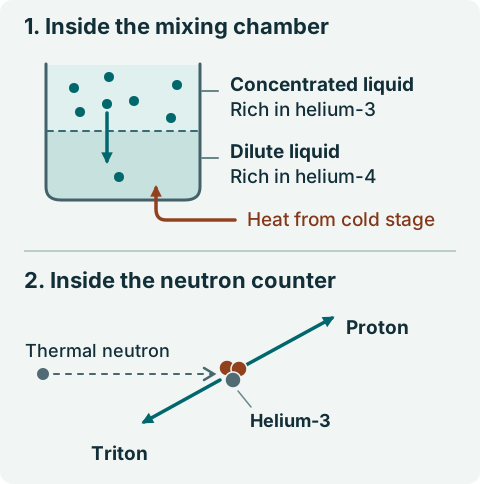
Cooling across a liquid boundary
At the cold end of the refrigerator, the two isotopes share a vessel called the mixing chamber. When the mixture is cold enough, two liquid layers form. One consists almost entirely of helium-3. The other contains mostly helium-4, which can still hold a small fraction of helium-3 even close to absolute zero.
It takes energy for a helium-3 atom to cross into the more dilute layer. The mixture draws that energy as heat from the chamber. A chip mounted on the outside of the cold stage loses heat through its mounting, even though it never touches the liquid.
A warmer vessel called the still keeps the cycle going. Helium-3 evaporates more readily there than helium-4. Pumps return the gas to the cooling circuit, where it condenses and passes through heat exchangers on its way back to the mixing chamber. The same atoms can make the journey many times. Their circulation rate helps determine how much heat the refrigerator can remove. Bluefors’ account of the cooling cycle.
Why put 742 kilograms of crystals in a refrigerator?
CUORE’s 988 tellurium dioxide crystals weigh 742 kg in total. The collaboration reports cooling some 1.5 tonnes of material, including the detector assembly, to about 10 millikelvin, one hundredth of a kelvin above absolute zero. At that temperature each crystal has a very small heat capacity. A passing particle can leave enough energy in one crystal to produce a temperature pulse that its thermometer can pick out. With a warmer crystal the same deposit of energy would give a smaller pulse. The CUORE collaboration’s measurement.
For someone specifying a refrigerator, this distinction matters. Two systems might reach the same temperature with nothing mounted on the cold stage. Add the instrument and there is heat to carry away, including heat conducted down wires. An engineer needs the cooling power available at the chosen operating temperature. A published specification for one commercial system, for example, gives a base temperature below 10 mK and more than 450 microwatts of cooling at 100 mK. Those numbers describe two different operating conditions. Bluefors LD performance specifications.
Turning a neutron into a pulse
A neutron carries no electric charge. For the electronics to register its arrival, something inside the tube must produce charge. A helium-3 nucleus readily captures a thermal neutron, producing a proton and a triton, the nucleus of a tritium atom. The two charged particles fly apart and knock electrons free from the gas atoms along their tracks.
An electric field draws the electrons towards a fine wire. Close to the wire, further collisions multiply the charge, producing a measurable current pulse. Helium-4 scarcely absorbs thermal neutrons, so substituting it would remove the capture mechanism that makes this counter work. NIST research on helium-3 proportional counters.
Consider where a neutron lands in the Maryland experiment. It has already scattered from a sample, and a silicon crystal sends neutrons of a selected energy back towards the detectors. Recording which tube fired tells the researchers the scattering angle. Counting the pulses as they vary the energy of the incoming beam gives them information about motion inside the original sample. The tube itself only has to record that a neutron arrived. The surrounding instrument gives that count its scientific meaning. How NIST measures neutron scattering.
What gas does the instrument require?
For a refrigerator, start with the manufacturer’s charge of each isotope. The 6.6% often quoted for a dilution refrigerator is the limiting fraction of helium-3 in the dilute liquid phase as the temperature approaches absolute zero. It describes one layer inside the running machine. A supplier needs the amounts to deliver for the complete circuit. Bluefors’ helium mixture phase diagram.
For a detector, geometry matters. NIST specifies a helium-3 fill pressure of 2.5 bar for three rectangular low-angle detectors and 6 bar for its high-angle tubes. At a given temperature, raising the helium-3 partial pressure places more target nuclei along a neutron’s path through the gas. This is why a useful order identifies the detector type, dimensions and specified gas fill. NIST’s detector dimensions and pressures.
A purchasing enquiry should distinguish isotopic enrichment, the fraction of helium atoms that are helium-3, from limits on traces of other gases. If the quantity is given in litres, at what temperature and pressure is that volume defined? Those details let a laboratory compare quotations for the amount of isotope its instrument needs. SG Trading’s helium-3 reference specification.